

First Impressions: Wild Tiled West
Does this polyomino title hold its own against the genre's best?
Hey everyone, and welcome back to Board Gaming with Bapter!
My friends and I got together for our monthly game night this past weekend, and we managed to get two games to the table: Wild Tiled West from Dire Wolf and Castle Combo from Pandasaurus Games. In this post, I’ll be sharing my first impressions of Wild Tiled West and whether it made a strong first impression.
I really like polyomino games, but I tend to not be great at them because empty spaces make my brain angry. Patchwork is the game in the genre that I have the most plays of, and it’s really neat to see how many games implement the mechanism in different themes from zoos to quilts to space and now the wild west.
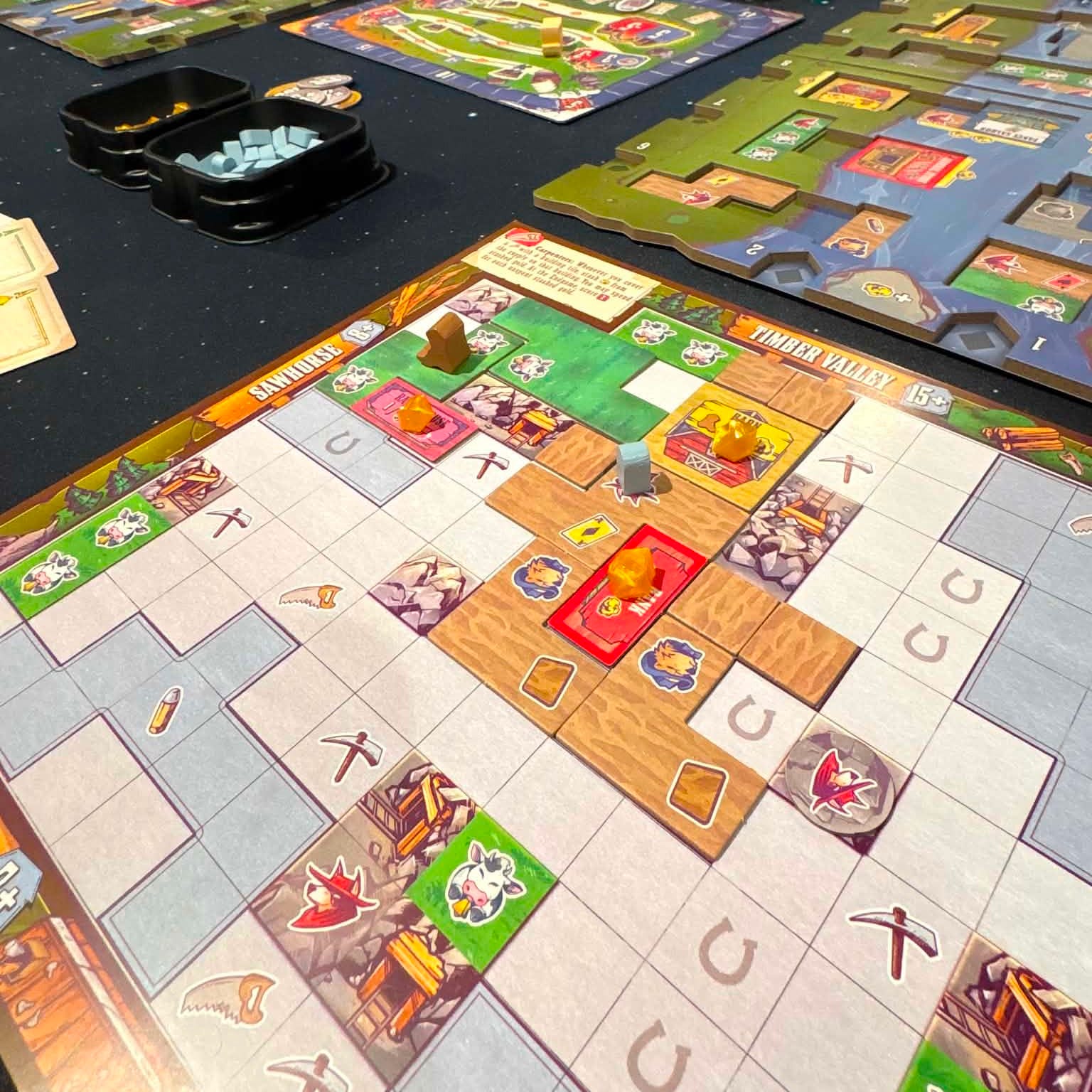
Gameplay Overview
In Wild Tiled West, players draft polyomino tiles onto their personal boards, trying to maximize points through connected pastures, defeated bandits, mining, buildings, ace sets, and partner goal cards.
Each player starts with a double sided board featuring a variety of icons and terrain. One side offers a more straightforward layout, while the other is asymmetric with unique starting conditions. Even though two of us, myself included, were learning the game, we opted for the asymmetric boards because they looked more interesting.
The game is played over four years. At the beginning of each year, players collect gold based on their position on the income track. After that, each round follows the same simple structure:
Roll the dice.
Place each die in its matching lane on the main board.
Draft tiles.
On your turn, you’ll choose a tile from a lane with a die assigned to it. For the green land lanes, only the tile in the front of the row is available until it’s taken, revealing the next option. River lanes work a little differently. You can pay extra gold to skip over tiles and grab exactly the one you want, giving you a bit more control when the perfect piece appears.
Your board and the tiles are covered with different icons that drive scoring and special abilities. Here’s a quick breakdown of what they all do.
Cows
Cow icons appear on pasture tiles. Once you’ve connected at least three cows into a single pasture, you can choose to wrangle them, scoring points based on the current value shown on the central scoring board.
The larger the connected herd, the more points you’ll earn. However, once a pasture has been wrangled, it can never be scored again. Any cows added to that same pasture later in the game won’t count, so separating your herds becomes an important strategic decision.
Sheriffs, Bandits, and Bullets
Sheriffs allow you to take down bandits, but only if they’re in a clear line of sight. Buildings, mountains, and cows all block your shot, so positioning matters quite a bit.
To defeat a bandit, you’ll first need to acquire a bullet through buildings, board spaces, or other card effects. Once you have one, you can spend it to eliminate a bandit in range, placing the bullet token on that space. Every defeated bandit is worth victory points at the end of the game.
Pickaxes and Gold Nuggets
Pickaxes improve your economy. Whenever you cover a pickaxe space or place a tile featuring one, you advance on the gold track, increasing the amount of gold you’ll collect at the start of each year. Advancing far enough also earns end game victory points.
Gold itself is primarily spent to draft tiles, especially when you want to skip ahead in the river lanes. Gold nuggets, meanwhile, provide immediate spending power. Whenever you cover or place a gold nugget icon, you simply take a gold from the supply instead of increasing your income.
Buildings
Buildings come in several varieties, with their colors indicating whether they provide an immediate effect, an ongoing ability, or end game scoring.
For example:
Banks award three gold once they’re completely surrounded.
Barns generate a gold every time you wrangle a pasture.
General Stores let you choose from several different resources once enclosed.
There are plenty of other buildings throughout the game, giving you lots of ways to tailor your strategy.
Aces
Ace icons don’t do anything during the game, but they can provide a healthy chunk of points at the end.
Scoring works much like poker. Collecting three aces of the same suit scores points, as does collecting one of each suit, with larger or more valuable sets rewarding even more. They’re easy to overlook early but can make a significant difference during final scoring.
Alleys
These icons appear as small brown squares on certain tiles. When you collect one, you gain a single square polyomino that you can place anywhere on your board. It’s a simple but useful tool for filling in awkward gaps or connecting two sections of your landscape that otherwise wouldn’t fit together.
End of the Year
Each year ends after three or four drafting rounds with a Tussle.
Players who have accumulated the most undefeated bandits lose points, while the player with the fewest gains points. The stakes increase as the game progresses, making it worthwhile to keep your board as free of outlaws as possible.
After the fourth year, players total points from, defeated bandits, buildings, the gold track, partner goal cards, ace sets, and any other scoring effects. You’ll also lose one point for every horseshoe space left uncovered on your board.
Whoever finishes with the most victory points wins. Shockingly, I came away with the win thanks to the asymmetric board scoring that I played with!
First Impressions
Final Thoughts
Overall, I enjoyed Wild Tiled West. It’s a solid entry in the polyomino genre, even if it doesn’t quite crack my top tier. There are certainly games in the genre I’d rather play, but there are also plenty I’d choose Wild Tiled West over.
What really helps it stand out is its theme. Every aspect of the production, from the artwork to the mechanics, leans into the Wild West setting in a way that feels cohesive. The iconography is also excellent. While there are quite a few symbols to learn, they quickly become second nature after a few rounds.
My favorite moment came late in the game when I managed to pull off a huge scoring combo with one of my buildings. The building awarded points for every cow on connected tiles, and I was able to link it to two massive pastures before the game ended. Pulling off that kind of engine building payoff was incredibly satisfying and made me appreciate how rewarding the puzzle can be.
My biggest criticism is the game’s length. Mechanically, it reminded me a lot of Planet Unknown, but by the middle of the third year I felt like I’d already seen what the game had to offer. After roughly 10 rounds of drafting, the experience started to drag a bit. Game box has it at 45-90 minutes, and our game probably was just short of two hours, including the usual chatting with friends. Even so, it felt long.
I’m not exactly sure how I’d solve that problem, but I do wonder if the game would benefit from some kind of dynamic end game trigger, such as ending once a certain number of tile rows or columns have been depleted. The length didn’t ruin the experience, but it will probably make me reach for games like Planet Unknown, The Isle of Cats, or Bärenpark first, as they deliver a similarly satisfying puzzle in a shorter amount of time.
We played with four players, and I could see that being close to the ideal count, though I suspect three may be the sweet spot. I haven’t tried it at two players, but from what I’ve read, the game tends to shine more at the higher player counts where competition over the tile market is tighter.
It’s always difficult to assign a rating after just one play, but based on my initial impressions, I’d give Wild Tiled West a 6.5/10. The game length is what keeps it from being a 7, and that could certainly change with future places. I’d happily play it again, especially with the right group, but for now it sits comfortably in the middle of the polyomino pact rather than near the top.
I enjoyed the game but definitely don't need it in my collection, even though I LOVE tile laying. But I'm glad my friend has it LOL.
Looks fun, finally getting an idea about a game so many people talk greatly about.