

Dueling for Middle Earth
An improved, elevated 2-player experience

Two-player board games are really the types of games that I gravitate toward because it’s our primary player count. So when it comes to games that are exclusively two players, they always have to get a fair look. One of the early ones we played was 7 Wonders Duel (7WD). Both my wife and I liked the game a lot, but it didn’t hit the table very often. From what I remember, it was during the height of the hobby when we were constantly buying and culling. Anyway, I continued to play 7WD with friends via the app and Board Game Arena.
When Lord of the Rings: Duel for Middle Earth was released, it didn’t jump out at me since I don’t really have a connection to the IP. My wife loves it. The longer it sat on the retail shelves, the more praise it received. So toward the end of last year, we picked it up on sale at Barnes and Noble and finally tabled it this past weekend.
Let me just say…it was an utter delight.


The New Stuff vs. The Old Stuff
The number of small improvements, gameplay tweaks, and additions really worked beautifully for me. I played it with my wife, then again a couple of days later with a friend who’s a big 7WD fan. Let’s chat through the new elements and how they compare to and elevate the original.
Picking a side
Just getting this out of the way for the other points in this segment. In Duel for Middle Earth, one player acts as The Fellowship and the other as Sauron. This meant nothing to me as the non-Lord of the Rings member of my family, but Sauron always goes first.
Conquering Middle Earth
The biggest addition is the area control map of Middle Earth. Instead of the straight military cards from 7 Wonders Duel, conflict cards let you place units and fortresses across seven regions. Most of these red-orange cards allow you to add units to one of two regions.
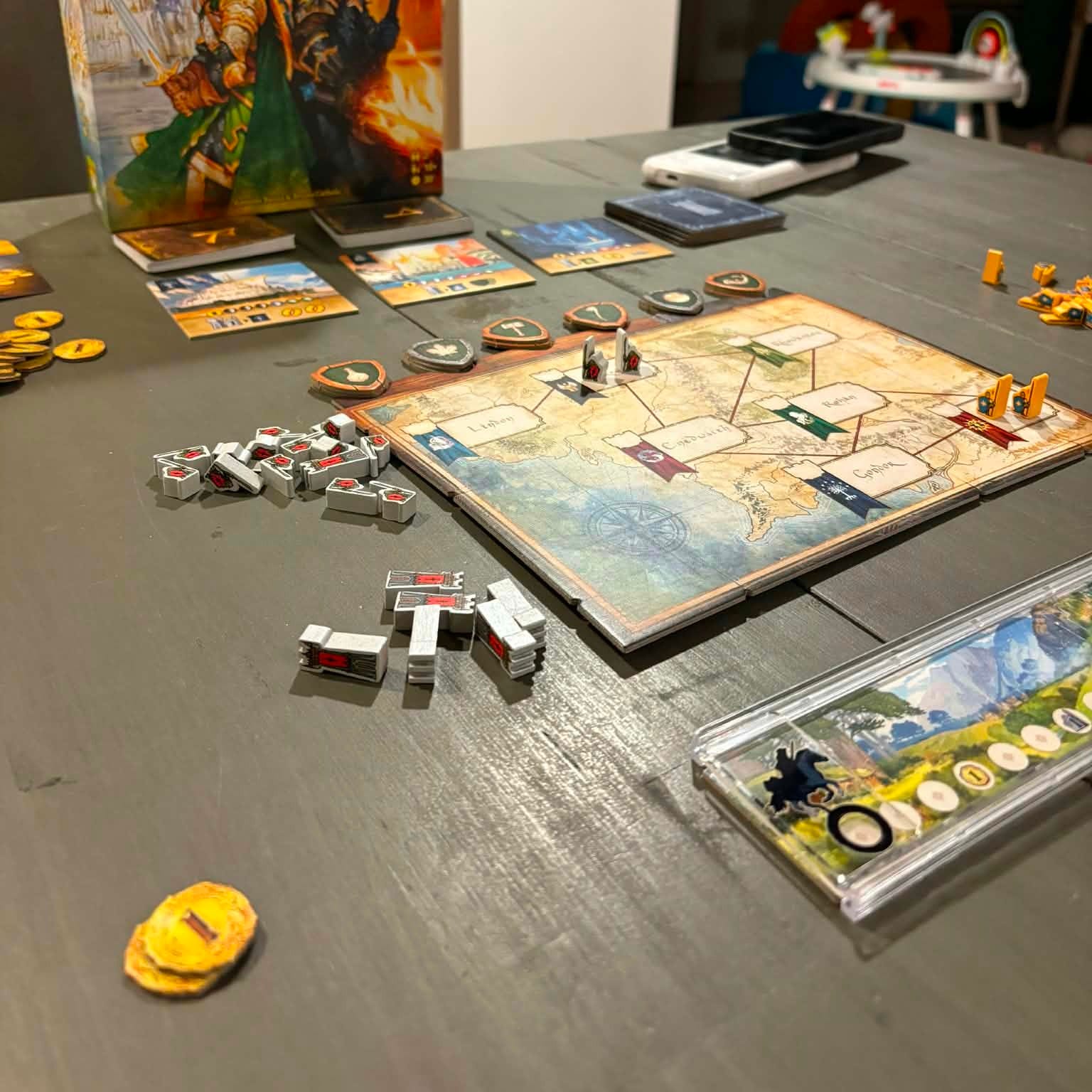
Conflict resolution is simple: if opposing units are present, players remove them until only one side remains, or both are gone. That can matter later if someone is close to the Conquering Middle Earth win condition, which requires having a unit or fortress in all seven regions. I didn’t focus on this much in my first play, but leaned into it more in the second to pressure my opponent and pull him away from other strategies. If none of the win conditions are met by the end of round three, the player who is present in the most regions wins.
I found this to be a much more interesting part of the game if I am comparing it to the military track from 7WD.
Landmarks & Fortresses
Since I have already mentioned fortresses, you add these to regions primarily by acquiring landmarks, which are essentially what this game uses as “wonders” in the 7 Wonders game series. In 7WD, you have your own four wonders to try and construct, but in LOTR (Lord of the Rings), there are three each round that represent a region of the map. You use the skill icons to pay for them and, like 7WD, get a benefit from it. There’s a landmark for each region, but that doesn’t mean you’ll get to all seven during a game. Each landmark tile allows you to put a fortress pawn in a corresponding region, which can only be removed through card abilities, and not general conflict.
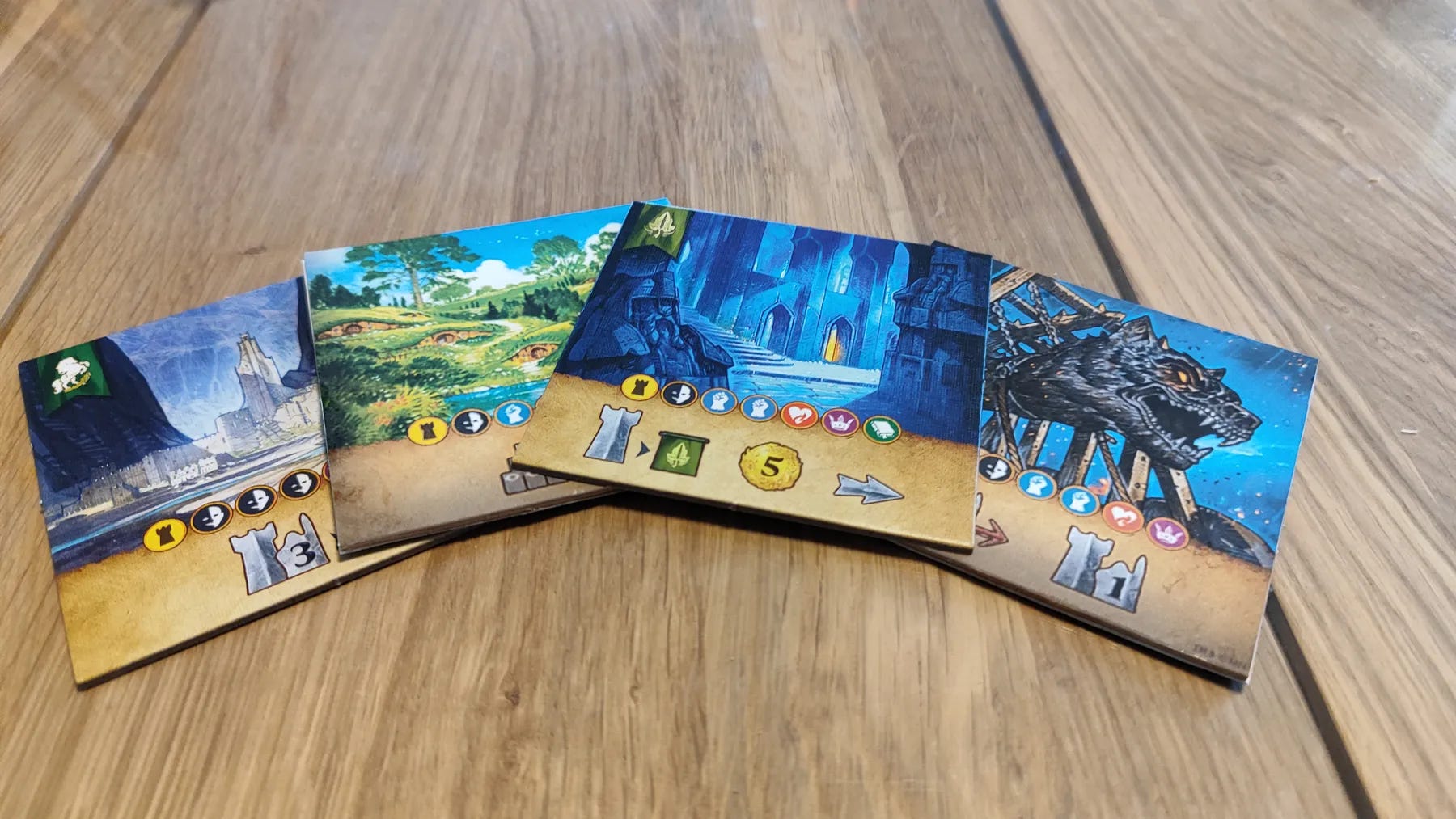
There are abilities that could give a player the combo to get multiple landmarks in one turn, which is super fun to pull off if you can. As is in 7WD, if you are missing icons that are needed to pay for the landmark(s), you can pay a coin in place of it. The landmarks include powers that range from placing more units in Middle Earth to moving units across the map or advancing your character in their…
…Quest for The Ring
What a segue. The blue cards from 7WD offer straight victory points, but in Duel for Middle Earth they move you along the Quest for the Ring track, which is the closest thing to the military tug-of-war from the original. Frodo and Sam are trying to reach Mount Doom before Sauron catches them, which introduces the second victory condition. If the Fellowship gets them to Mount Doom, they win. If Sauron catches them, Sauron wins. I found this more fun than the military track in 7WD and definitely more interesting than simple victory points.
Clan Influence
This is the gameplay equivalent of 7WD’s green scientific symbols, but a superior version. The goal is the same for victory — collect all six clan symbols and you win. Each clan has a stack of three tokens. If you ever have two matching clan symbols, you draw the top two tokens from that clan, keep one, and return the other.
Each token grants either an immediate ability, like taking another turn, advancing on the quest track, or placing units in Middle Earth, or a passive bonus that triggers when you play certain cards. I had one that advanced me on the quest track every time I played a yellow coin card.
I found this version of the science system much more fun. I rarely chased a scientific victory in 7WD, but I found myself going for it in both of my plays here.
If It Ain’t Broke, Don’t Fix It!
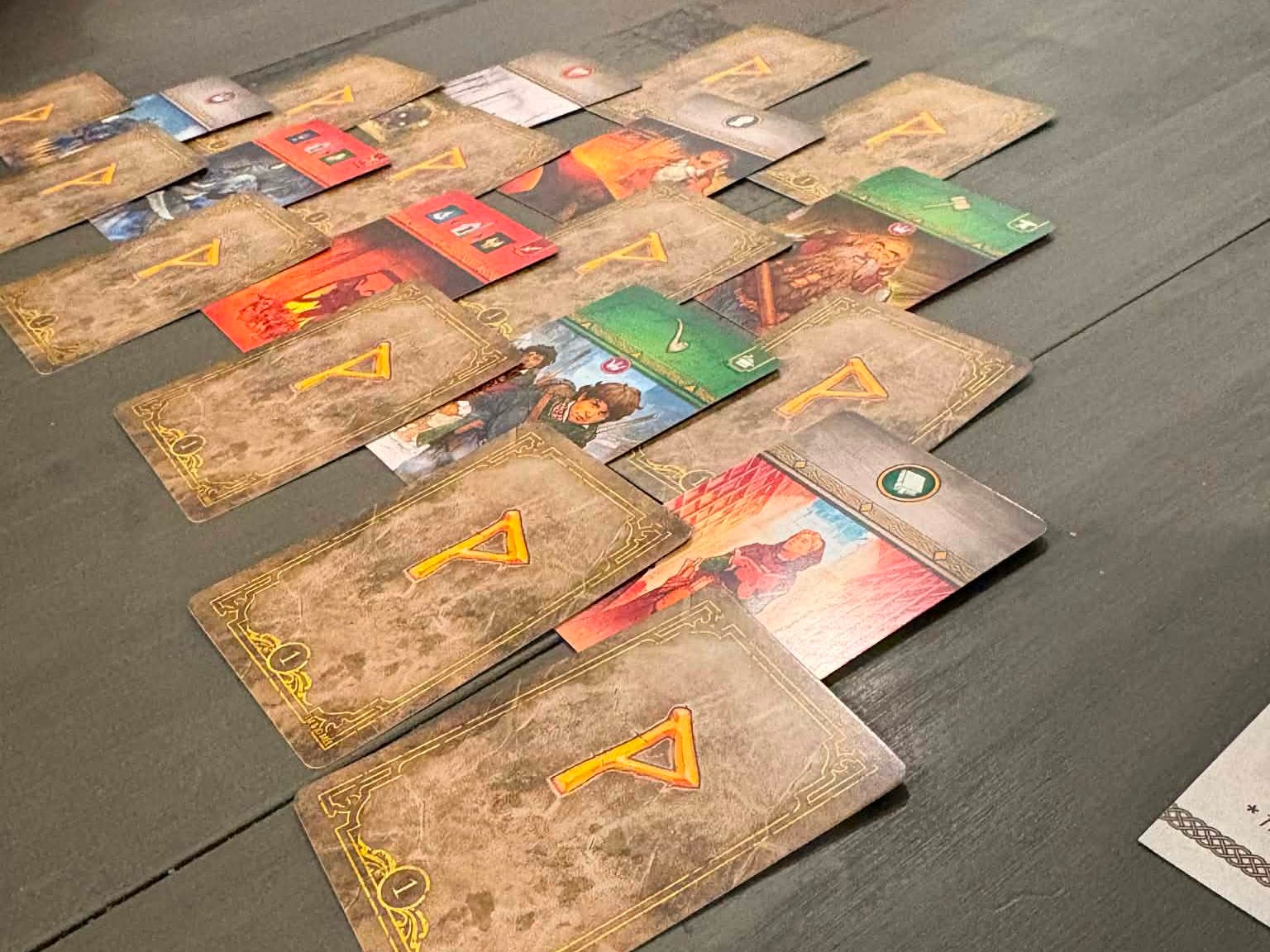
At its core, Lord of the Rings: Duel for Middle Earth is a streamlined evolution of an already great two-player experience. I like both games, but this is my preferred way to play going forward. The returning concepts all work nicely, even with the slight tweaks. The card setup and construction are still satisfying, and the building material cards shifting from brown and gray to just gray skill cards feels seamless.
After two plays, this is easily an 8/10 for me, and it wouldn’t shock me if that moves to an 8.5 with more plays.
Great write up there. I love both games and am excited to dive into the expansion for Duel for Middle Earth at some point, too.
Funny you mention never going for a science win in 7WD. Because that is from my feeling what I win with most. I can win if I manage to end the game early, but if we play until the game ends, I never win by VP.